13 · Anthropic's own training material
What Anthropic publishes to teach its own products, what's worth assigning, what to avoid putting in front of executives — and the substantial gaps you will have to fill yourself.
The headline: /learn is a router, not a curriculum
anthropic.com/learn is branded "Anthropic Academy", with the subhead: "Get in the know with Anthropic resources. From API development guides to enterprise deployment best practices, the academy has you covered."
It contains seven items: three persona tiles, two featured courses, a link to the course platform, and a newsletter signup. That is the entire hub.
The genuinely valuable executive material is not on /learn and is not linked from it. The hub omits the course catalogue with durations, the Cowork deployment guide and its maturity model, the role-specific Cowork tutorials, the customer stories, and the communications kits. Build from /learn alone and you will produce a developer-flavoured curriculum and miss most of what you need.
Where the material actually lives
| What you want | Where it actually is | Linked from /learn? |
|---|---|---|
| Course catalogue with durations and categories | claude.com/resources/courses | ✗ |
| Adoption maturity model & rollout roadmap | The Cowork deployment PDF — see §12 | ✗ |
| Role-specific Cowork walkthroughs | claude.com/resources/tutorials | ✗ |
| Customer stories with figures | claude.com/customers | ✗ |
| Rollout comms templates | Claude Code communications kit — see §12 | ✗ |
| Courses (no durations, no categories) | anthropic.skilljar.com | ✓ |
| Business-oriented link hub | /learn/claude-for-work | ✓ |
| Developer link hub | /learn/build-with-claude | ✓ |
| Personal / AI Fluency hub | /learn/claude-for-you | ✓ |
The course catalogue
All courses are free, hosted on Skilljar under Anthropic branding, require an account signup, and most award a certificate of completion. Verified directly against claude.com/resources/courses on 2 August 2026.
Professional — the executive-relevant track
| Course | Duration | Content | Executive fit |
|---|---|---|---|
| Claude 101 | 1 hr | 12 lectures | ✓ The clean on-ramp |
| Introduction to Claude Cowork | not published | 5 modules, ~17 lessons + quiz | ✓ The only Cowork course |
| AI fluency: Framework and foundations | 1.1 hr | 14 lectures, 1 quiz | ✓ Role-agnostic, framework-led |
| AI Fluency for Builders | 1 hr | 10 lectures, 1 quiz | ◐ "Builders" skews technical |
| AI Fluency for Small Businesses | 0.9 hr | 9 lectures, 1 quiz | ◐ Names "leadership roles"; SMB framing |
| AI Fluency for pK-12 Educators | 1 hr | 8 lectures, 1 quiz | ✗ Wrong audience |
Engineering — do not assign to executives
| Course | Duration | Content |
|---|---|---|
| Claude Code 101 | 1 hr | 12 lectures |
| Claude Code in Action | 1 hr | 15 lectures, 1 quiz |
| Introduction to subagents | 20 mins | 4 lectures |
| Introduction to agent skills | 30 min | 6 lectures |
| Claude Platform 101 | 1 hr | 12 lectures, 1 quiz |
| Introduction to Model Context Protocol | 1 hr | 16 lectures, 1 quiz |
| Model Context Protocol: Advanced Topics | 1.1 hr | 15 lectures, 2 quizzes |
| Building with the Claude API | 8.1 hr | 84 lectures, 10 quizzes |
| Claude with Amazon Bedrock | 8 hr | 85 lectures, 10 quizzes |
| Claude with Google Cloud's Vertex AI | 8 hr | 85 lectures, 10 quizzes |
Education & Nonprofits
| Course | Category | Duration | Content |
|---|---|---|---|
| AI capabilities and limitations | Education | 15 min | 13 lectures, 1 quiz |
| AI Fluency for Educators | Education | 24 min | 4 lectures |
| AI Fluency for Students | Education | 30 min | 5 lectures |
| Teaching AI Fluency | Education | 36 min | 7 lectures, 1 quiz |
| AI Fluency for nonprofits | Nonprofits | 54 min | 9 lectures, 1 quiz |
AI capabilities and limitations (15 min, Education) is the best short literacy module Anthropic publishes for a leadership audience, despite being filed under Education. If you have fifteen minutes of pre-work to assign before an executive session, use this.
The three courses worth assigning
1 · Claude 101 — the executive on-ramp
Modules: Meet Claude (what it is, first conversation, getting better results, working on desktop) · Organizing your work and knowledge (projects, artifacts, skills) · Expanding Claude's reach (connecting tools, enterprise search, research) · Putting it all together (use cases by role) · Conclusion & certificate.
2 · Introduction to Claude Cowork — the only Cowork course
Anthropic's description, verbatim: "Cowork is Claude working directly with your files, folders, and apps — reading, editing, and producing real outputs on your machine."
| Module | Covers | Maps to |
|---|---|---|
| 1 · Meet Claude Cowork | What it is, setup, what it can do, first task | §02, §04 |
| 2 · Make Claude Cowork yours | Better results; standing context (global instructions and projects); skills; "plugins: encode your team's expertise" | §06 |
| 3 · Use Claude wherever you work | Claude in Chrome; Claude for Microsoft 365 | §05 |
| 4 · Sharing and safety | Working safely; validating skills for plugins; sharing with your team | §08 |
| 5 · Wrap up | Check your understanding; quiz | — |
Note that its module 2 language — "standing context", "encode your team's expertise" — is the same conceptual ladder as the maturity model in §12. Consistent vocabulary across Anthropic's material is useful; borrow it.
3 · AI Fluency: Framework and Foundations
Built with Prof. Joseph Feller (University College Cork) and Prof. Rick Dakan (Ringling College). 14 lectures. Its framework is the most reusable conceptual asset Anthropic publishes — see below.
The AI Fluency 4D framework
Framing line, verbatim: "Four interconnected competencies necessary to ensure our interactions with AI are effective, efficient, ethical and safe."
| Competency | Definition (verbatim) |
|---|---|
| Delegation | "Setting goals and deciding whether, when and how to engage with AI." |
| Description | "Effectively describing goals to prompt useful AI behaviors and outputs." |
| Discernment | "Accurately assessing the usefulness of AI outputs and behaviours." |
| Diligence | "Taking responsibility for what we do with AI and how we do it." |
Three modes of AI interaction
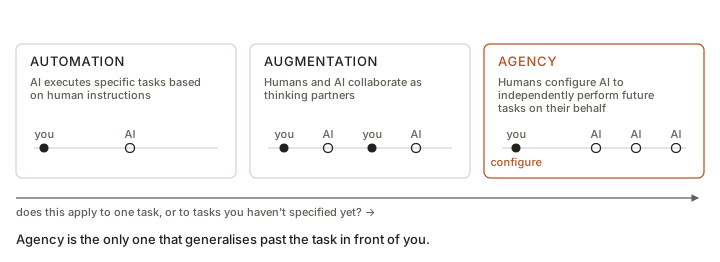
| Mode | Definition (verbatim) | Product analogue |
|---|---|---|
| Automation | "AI executes specific tasks based on human instructions" | Chat; a single-step prompt |
| Augmentation | "Humans and AI collaborate as thinking partners" | Interactive Cowork or Claude Code session |
| Agency | "Humans configure AI to independently perform future tasks on their behalf" | Skills, plugins, scheduled tasks, Routines, Dispatch |
The three modes map almost perfectly onto the maturity ladder in §12 and onto the autonomy spectrum in §07. Automation ≈ Level 0. Augmentation ≈ Levels 1–2. Agency ≈ Levels 3–4. That gives you one vocabulary spanning literacy, product choice, and organisational maturity — which is exactly what a curriculum needs and what Anthropic never assembles in one place itself.
Also referred to as named modules: the Description-Discernment loop and the Delegation-Diligence loop.
These two loop names come from the course module listing on Skilljar, which is behind a login. They do not appear in the public AI Fluency one-pager PDF, which presents the four competencies as a flat set with no loop structure. So any argument built on the loops — including the nested reading in §14 — rests on a source neither this pack nor an independent reviewer could open. Enrol in the free course and confirm before you teach the loop structure as Anthropic's.
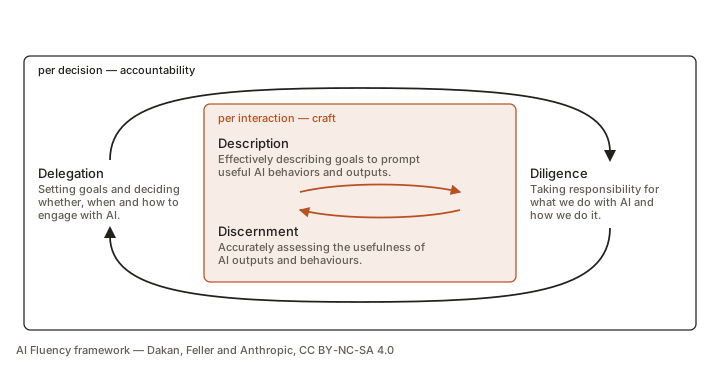
The framework artefacts are released under CC BY-NC-SA 4.0 (Copyright 2025 Rick Dakan, Joseph Feller, and Anthropic). The non-commercial clause restricts reuse of the diagram and wording as-is in paid material. Fine for internal and personal use; revisit if this ever becomes commercial output. Redrawing the concepts in your own visual language and mental model sidesteps the question entirely and produces better teaching material anyway.
Role guides and tutorials
Role guides (Help Centre, no signup)
Linked from /learn/claude-for-work: Claude for Engineering · Human Resources · Marketing · Product Management · Sales. Short, practical, and safe to hand out as-is.
Cowork tutorials — the role-specific walkthroughs
At claude.com/resources/tutorials, none linked from /learn:
- Delegating your first task in Claude Cowork — video, 5 min. The single best asset for opening a session.
- Customize Claude Cowork — connectors, projects, skills, browser use
- Using Claude Cowork for legal: answer fast questions on past decisions
- Using Claude Cowork for sales: research any account before the first call
- Using Claude Cowork for marketing ops: run a weekly review that preps itself
- Using Claude Cowork for your small business
- AI literacy set: how AI gets its character · knowledge gaps · sycophancy · why models hallucinate
- Claude Design for prototypes and UX; for presentations and slide decks
The tutorials index also exposes Anthropic's own working taxonomy, which is a useful sanity-check on curriculum scope:
| Axis | Values |
|---|---|
| Category | AI Fluency · Claude Science · Education · Engineering · Finance · Healthcare · HR · Life Sciences · Marketing · Nonprofits · Professional · Sales · Small Business |
| Features | Artifacts · Connectors · Projects · Research · Skills · Browser Use |
| Products | Claude Science · Claude Security · Claude Design · Claude in PowerPoint · Claude in Excel · Claude Cowork · Claude in Chrome · Claude Code · Claude.ai |
Certifications
Four role-based certifications, delivered through the Anthropic Partner Academy (training free), examined via Pearson Professional Assessments (proctored, identity-verified), with badges issued through Credly by Pearson.
| Certification | Target role | Tests |
|---|---|---|
| Claude Certified Associate: Foundations | Consultants, project leads, professionals with business or technical expertise | "practical, everyday use of Claude" |
| Claude Certified Developer: Foundations | Engineers building applications | Claude API, tool use, agent development |
| Claude Certified Architect: Foundations | Solution architects designing agent systems | Foundation-level architecture |
| Claude Certified Architect: Professional | Advanced architects at large enterprises | Integration architecture, governance, evaluation |
Structure, verbatim: "Every path to getting credentialed starts with a foundation-level certification and advances to the professional-level."
Scale figures Anthropic publishes: more than 36,000 consultants certified across more than 1,300 organizations; more than 400,000 people have completed Claude training through the Partner Academy this year; a $100M commitment to the Claude Partner Network for 2026.
Certification pricing and syllabi could not be confirmed. claude.com/resources/certifications and claude.com/partners/certifications both return 404 — the first is a broken link on Anthropic's own courses page — and claude.com/certifications redirects to a login-gated page. Only the Associate track is aimed at non-engineers. Do not quote a price.
How Anthropic organises all this — and why it doesn't reconcile
Three overlapping taxonomies, which is worth knowing so you don't try to inherit a structure that isn't there:
/learnpersona split — Build with Claude · Claude for work · Claude for personal- Course catalogue categories — Professional · Engineering · Education · Nonprofits
- Product-line tagging — AI Fluency · Claude.ai · Claude Cowork · Claude Code · Claude Platform · MCP
There is no numbered level system, no prerequisite chain, and no named executive persona anywhere in the public learning material. "101" is a naming convention, not a track. The only genuine maturity model Anthropic publishes is the five-level Cowork ladder in §12 — and it is not part of the Academy at all.
A telling detail: /learn/claude-for-work, the business page, lists five courses under "Claude for Work Courses" — two of which are for nonprofits and educators.
Gaps you will have to fill yourself
| Gap | Detail |
|---|---|
| No executive persona | Courses target developers, students, educators, nonprofits, small businesses and "builders." No C-suite course, no board-level module. The closest proxy merely mentions "leadership roles" in an SMB audience list. |
| No facilitation material | Everything is self-paced async video. No slide decks, facilitator guides, workshop scripts, discussion prompts or cohort structure. This pack's §11 exists precisely because Anthropic doesn't publish one. |
| No real assessment | Multiple-choice quizzes only. No capability rubric, no maturity self-assessment instrument, no pre/post diagnostic. The certifications are proctored but partner-gated and role-mismatched for internal audiences. |
| No ROI or business-case model | Metrics are listed; methods are not. No cost model, no TCO framework, no payback calculator, no benefits-realisation template. Customer figures are outcomes, not methodologies. |
| No Cowork communications kit | Claude Code has a 20-message drip campaign and exec-sponsor templates. Cowork — the product executives will actually use — has nothing equivalent. |
| Nothing on organisational design | No guidance on headcount, job architecture, career ladders or performance management when Level 4 plugins absorb routine work. Anthropic's Economic Index work exists separately and is not integrated. |
| No leader-facing risk curriculum | Security is documented for admins (RBAC, spend limits, telemetry). There is no executive module on AI risk appetite, model-failure liability, regulatory exposure or board reporting. |
| Shallow depth overall | Total Professional-track content is roughly five hours, nearly all sub-hour modules. These are on-ramps, not a curriculum. |
Anthropic gives you good on-ramps (Claude 101, Intro to Cowork), a good conceptual frame (4D + three modes), and a good adoption model (§12). It gives you no depth, no facilitation, no assessment, no ROI method and no executive voice. Assign their courses as pre-work; the session itself is yours to build — and the gap list above is effectively a specification for what makes your material worth paying for.
Suggested pre-work assignment
| # | Assign | Time | Why |
|---|---|---|---|
| 1 | AI capabilities and limitations | 15 min | Baseline literacy; prevents the session being derailed by "does it hallucinate?" |
| 2 | Claude 101 | 1 hr | Shared vocabulary — projects, artifacts, skills, connectors — before you compare products |
| 3 | Delegating your first task in Claude Cowork (video) | 5 min | They arrive having seen the interaction model, not just heard about it |
| 4 (optional) | AI fluency: Framework and foundations | 1.1 hr | Only if you intend to build the session on the 4D vocabulary |
Total mandatory pre-work: ~80 minutes. All free, all self-paced, all certificated — the certificate is a surprisingly effective completion lever with senior audiences.