12 · Anthropic's adoption frameworks
Anthropic publishes its own maturity model, rollout roadmap, use-case selection criteria and governance postures — mostly in places its learning hub never links to. These are the most directly liftable assets found anywhere in the official material.
Primarily Deploying Claude Across Your Organization, a 22-page PDF published 29 April 2026 and linked from this blog post. Direct PDF: Claude-Deploying-Claude-Across-Your-Organization-04292026.pdf — ungated, no form. Supplemented by the Cowork Enterprise Administrator Guide and the Scaling Workflows playbook. Full citations in §16.
The five-level maturity model
This is the single best asset in Anthropic's published material, and it does not appear in the product documentation at all. It gives an executive audience a ladder rather than a binary.
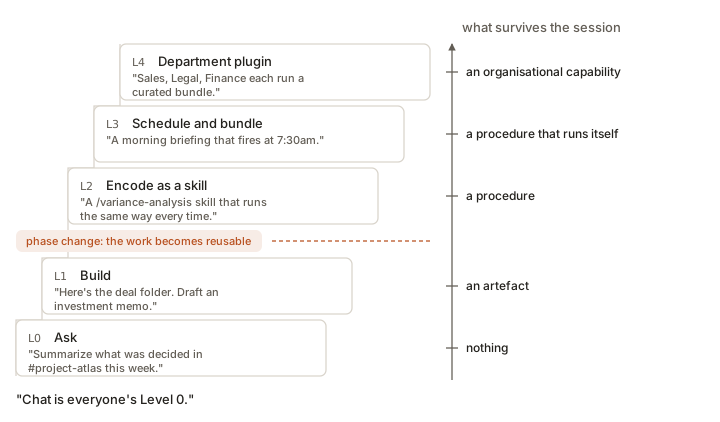
| Level | What it looks like (verbatim) | Example (verbatim) |
|---|---|---|
| 0 | "Use Cowork as a chat Q&A. Connect Slack or Drive, ask a question, get an answer." | "Summarize what was decided in #project-atlas this week." |
| 1 | "Building something. Claude reads your files and connects to your tools to create something new: a deck, an email, a spreadsheet, a diagram. Your data and systems are your oyster." | "Here's the deal folder. Draft an investment memo." |
| 2 | "Turn it into a skill. One markdown file runs the same task the same way every time." | "A /variance-analysis skill that knows your tables, your thresholds, and your CFO's preferred format." |
| 3 | "Bundle skills, build your own, and schedule them to run on their own. Have the skill return analysis or run a daily workflow." | "A morning briefing that fires at 7:30am, pulling calendar, pipeline, and overnight Slack into one page." |
| 4 | "Create a plugin for every department. Sales, Legal, Finance, Marketing each run a curated, admin-provisioned bundle." | "Anthropic's Legal plugin: intake triage, regulatory monitoring, and exec updates, encoded once and shared with the whole team." |
The framing line — the best positioning sentence Anthropic has published"Chat is everyone's Level 0. Claude Cowork is where Levels 1 through 4 happen for knowledge work, and Code is where the same progression happens for engineering."
This is a cleaner articulation of the same-engine-two-products point than anything in the product documentation, and it maps directly onto §02. It also reframes the extensibility ladder in §06 — instructions → skills → plugins — as an organisational progression rather than a technical one.
And the expectation-setting line that goes with it"The job of a deployment is to get every user one level higher than they are now and to make sure the path upward is paved; nobody needs to reach Level 4 in the first month."
Run it as a self-assessment. Show the five levels, ask everyone to place themselves and their team, then ask what specifically is blocking the next rung. It converts an abstract "should we adopt AI" conversation into a concrete, per-person next action — and it surfaces the real blockers (usually access, not capability).
Chat vs Cowork vs Code — Anthropic's own surface-selection table
Published in the same guide. It independently corroborates the decision logic in §10, which is worth knowing: you are not extrapolating, you are agreeing with them.
| If the task is… | Reach for | Why |
|---|---|---|
| "A question, a rewrite, a quick brainstorm" | Chat | "Fast, conversational, no setup" |
| "Research, analysis, or a finished document built from your files and systems" | Claude Cowork | "Folder access, connectors, skills, scheduled runs" |
| "Writing, testing, or shipping software" | Claude Code | "Codebase access, diffs, git, dev environments" |
"The three share the same Claude underneath; what changes is the workspace around it."
Choosing a first use case — four criteria
Verbatim from the guide's "Choosing your first use case" section. Note that the fourth is doing real work — it is the one that argues for encoding tacit expertise rather than automating obvious drudgery.
| Criterion | Anthropic's wording |
|---|---|
| High volume, high repetition | "Work that happens dozens of times a week and follows a knowable pattern, like meeting prep docs or data pulls." |
| Information-dense synthesis | "Anywhere a human is spending time being the integration layer between systems, including pipeline reviews, regulatory monitoring, and quarterly financial reports." |
| Bottleneck-creating work | "Speeding up cross-functional work… doesn't save one person time; it unblocks everyone downstream." |
| Expertise-dependent but process-driven | "…the work only your best people do well today, because they've internalized a process nobody wrote down–fit the bill. This category pays back the most: encode that process in a skill and everyone on the team inherits it." |
The line that reframes the whole value proposition"When your best analyst's workflow lives in a skill rather than in her head, it stops being tribal knowledge and becomes organizational infrastructure."
And the accompanying claim about where the return actually shows up:
"This is where functional leads tend to see the biggest return—not doing the same work faster, but doing the work that mattered but was never a P0."
The six-month adoption roadmap
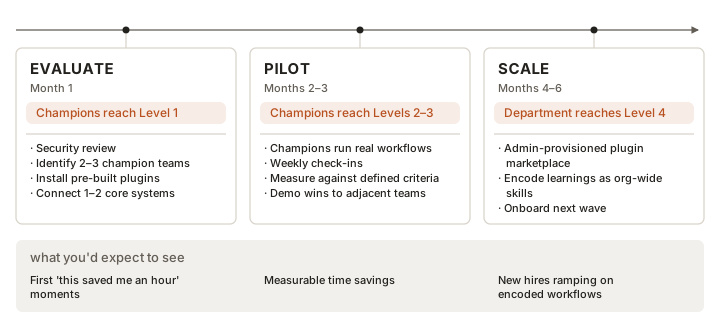
| Phase | Timeline | Target level | Actions (verbatim) | What you'd expect to see (verbatim) |
|---|---|---|---|---|
| Evaluate | Month 1 | Champions reach Level 1 | "Security review. Identify 2–3 champion teams. Install pre-built plugins. Connect 1–2 core systems." | "Champions reporting back use cases. First 'this saved me an hour' moments." |
| Pilot | Months 2–3 | Champions reach Levels 2–3 | "Champions run real workflows. Weekly check-ins. Measure against defined criteria. Demo wins to adjacent teams." | "Measurable time savings. Champions building and scheduling custom skills. Pull from other teams." |
| Scale | Months 4–6 | Department reaches Level 4 | "Admin-provisioned plugin marketplace. Encode pilot learnings as org-wide skills. Onboard next wave." | "Skills shared across teams. New hires ramping on encoded workflows. Declining support tickets for 'how do I.'" |
Compare this against the staged path I proposed in §10. They agree on shape — champions first, encode second, distribute third — but Anthropic's is more concrete on timing and mine adds the instrumentation step. Use whichever suits the room; say which one you're showing.
Starting points and metrics by function
| Function | First use case | What you'd measure |
|---|---|---|
| Legal | NDA review and redline against your playbook | Review turnaround time; queue depth |
| Finance | Variance analysis with root-cause commentary | Time from close to narrative; analyst hours per cycle |
| Sales | Pre-call research and brief generation | Prep time per call; rep-reported confidence |
| Product | PRD drafting from customer feedback and analytics | Time to first reviewable draft |
| HR | Performance review drafting from rubric and manager notes | Cycle completion rate; manager time per review |
| Marketing | Campaign brief draft against brand guidelines | Concept-to-review time; rounds of revision |
Give each executive the row for their function and ask them to name the specific instance — the actual NDA queue, the actual close cycle. Then ask for a current baseline number. Most cannot produce one, which is itself the finding: you cannot demonstrate ROI on a process you have never measured. That realisation lands harder than any demo.
Measuring adoption — the three-question model
From the Cowork Enterprise Administrator Guide:
| Question | Measures |
|---|---|
| "Are people using it?" | Activation rate, weekly actives, return rate |
| "How deeply?" | Sessions per user, advanced-feature uptake, days to first real task |
| "Is it paying off?" | Hours reallocated, named wins, cost-to-value comparison |
Note the dependency this creates: on Cowork, questions one and two require the OpenTelemetry pipeline described in §08 — which is Team/Enterprise only. On Claude Code, the analytics dashboard covers it natively. If you intend to measure a Cowork rollout, the telemetry has to be stood up before the pilot starts, not after.
Three governance postures
From the Scaling Workflows playbook. This is the cleanest published answer to "how much should we let people build?"
| Posture | What users can do | Fits an organisation that… |
|---|---|---|
| Admin Curated | Consume only admin-provisioned skills and plugins; no peer sharing | Is regulated, or is early and wants a controlled first wave |
| Guided Creation | Build and share peer-to-peer; champions promote vetted skills to department plugins | Has champions in place and wants bottom-up discovery with a review gate |
| Fully Open | Create, share peer-to-peer, and publish org-wide; admins monitor adoption | Has high trust and mature internal norms |
Accompanying numbers from the same source: one champion per 25–50 users, and a Phase 1 target of over 70% weekly active users by week 4.
The risk framing Anthropic uses — and it's a good one"When individuals adopt AI tools without oversight you get shadow AI: dozens of private workflows nobody can see, audit, or improve."
Deploying Claude Across Your Organization, p.11 — not the Scaling Workflows playbook quoted above it.
Pair this with the Cowork-specific fact from §08: Cowork projects are not shareable and local session data is not centrally managed. The product's own defaults push toward exactly the shadow-AI state this warns about. Naming that tension is the most useful thing you can do for a risk stakeholder.
The adoption argument, in Anthropic's words
"Deploying the technology is the easy part; getting an organization to actually use it is much harder."
"Define success before you start among relevant stakeholders. 'Hours saved per week' is measurable. 'Transformation' is not."
"The pattern is bottom-up discovery, top-down scale."
"You don't need every employee using the same plugins to call a deployment successful. You need every employee more productive than they are today, and a clear path to the next rung of the adoption ladder."
Claude Code's parallel rollout model
From Scaling Agentic Coding Across Your Organization. Structurally the same shape as the Cowork roadmap, with an engineering flavour:
- Start with super users — a pilot group of 20–50 developers already using AI tools.
- Launch with a hackathon — an org-wide kickoff event.
- Scale through internal expertise — the pilot group becomes the advisory body.
Proposed ROI metrics: sprint throughput · task completion time · migration velocity · developer satisfaction · onboarding duration · cross-functional efficiency.
"Agentic coding shifts software development from writing every line to guiding implementation."
Named customer outcomes
Useful because they are attributable and quantified. Use sparingly — one or two, chosen for resemblance to the room.
| Organisation | Outcome as published | Product |
|---|---|---|
| Jamf | Performance-review spreadsheet turned into a Cowork skill in 45 minutes, replacing "a quarter of engineering time and a custom internal app." | Cowork |
| Zapier | Product-marketing homepage prototyping: 15 minutes to a shareable HTML mockup. | Cowork |
| Thomson Reuters | Piloted Cowork with Claude Enterprise across non-software teams. | Cowork |
| Airtree | Board-prep workflows assembled from portfolio Drive, Slack and competitor news. | Cowork |
| Anthropic (internal, Legal) | Plugin built in an afternoon; 742 Jira tickets analysed to restructure intake; biweekly exec updates cut from "the better part of a day" to "a fraction." | Cowork |
| Anthropic (internal, Finance) | Dashboard production from "weeks to hours" via a data skill. | Cowork |
| Novo Nordisk | Clinical study documentation "10+ weeks to 10 minutes"; "90%" reduction in writing times on Clinical Study Reports; "95% reduction" in resources needed for device verification protocols. | Claude Code |
| Palo Alto Networks | "20-30% increase in feature development velocity"; junior developers "70% faster" on integration tasks; "2,500 developers" onboarded, "3,500 developers onboarded and ramping up". | Claude Platform on Google Cloud — not Claude Code |
| IG Group | "70 hours saved weekly for analysts"; "less than 3-month payback period"; "100% productivity increase in certain cases". | Claude Enterprise ("Claude for Work") |
| Cox Automotive | "2x increase in consumer lead responses and test drives"; "80% positive feedback from sellers using AI listings"; "9,000+ client deliverables". | Claude Platform via Amazon Bedrock — not an agentic-product story |
Quotable customer lines
"Claude Cowork helps teams do work at a scale that was hard to justify before. The human role becomes validation, refinement, and decision-making. Not repetitive rework."
— Joel Hron, CTO, Thomson Reuters
"What would have required a team of engineers building a custom React app, Claude Cowork delivered in 45 minutes. And it's more adaptive than anything we would have built."
— Matt Benyo, Director of AI Initiatives, Jamf
"The barrier between 'having an idea' and 'shipping something' has collapsed."
— Larisa Cavallaro, Zapier
The four enterprise-wide rows were re-verified against their case-study pages on 2 August 2026, and two things came out of that worth knowing.
Only Novo Nordisk is a Claude Code story. Palo Alto Networks is Claude Platform on Google Cloud (Claude 3.5 Haiku for code completion, Sonnet for IDE chat), Cox Automotive is Claude Platform via Amazon Bedrock, and IG Group is Claude Enterprise. They are real outcomes, but they are not evidence for Cowork or Claude Code, and presenting them as such in a session comparing those two products would be a misattribution. Use them for "what enterprises get from Claude", not for "what these two products do".
A "review cycles down 50%" figure previously attributed to Novo Nordisk here does not appear on the page and has been removed. The Cox Communications "7× ROI" figure remains unverified — it is a different company from Cox Automotive; check claude.com/customers/cox-communications-qa before citing it.
Two more assets worth knowing about
The Claude Code communications kit — drop-in change management
A complete rollout comms package: launch announcement with audience variants, a 20-message drip campaign for Slack or Teams, and a quick-reference FAQ. Its pre-launch checklist includes "Recruit C-suite sponsor (exec-sent launches show higher adoption)," and there is a dedicated Executive Sponsor Send variant.
"The announcements that actually drive adoption are the ones that read like someone at your company wrote them."
Anthropic's own caveat on the kit: it is "draft copy, not finished copy."
There is no Cowork equivalent. Which is an odd gap, given Cowork is the product a non-engineering rollout actually needs comms for. The Claude Code kit adapts with moderate effort.
The open-source plugin library
Anthropic publishes plugins covering "sales, legal, finance, marketing, product, HR, and more," and has open-sourced its own Legal plugin. These make excellent lab exercises: install one, read the skill files, then modify one for the participant's own team. It turns the abstract Level 2→4 progression into something they touch.