02 · What each product is
Official definitions, positioning, intended audience, and the shared lineage — with the exact wording Anthropic uses, so you can quote rather than paraphrase.
Claude Cowork
Anthropic's definition
Verbatim — Cowork docs overview"Cowork uses the same agentic architecture that powers Claude Code, accessible within Claude Desktop without opening the terminal. Rather than responding to prompts sequentially, Claude tackles intricate, multi-step tasks autonomously. Describe a desired outcome, then return later to completed work — polished documents, organized files, synthesized research, and more."
claude.com/docs/cowork/overview
Elsewhere Anthropic calls it "our new knowledge work agent" and "Anthropic's agentic workspace." The product page's own framing is that it "completes tasks you can steer from anywhere."
The four documented key capabilities
| Capability | What the docs say |
|---|---|
| Works directly on your computer | "Claude reads and writes local files without requiring manual uploads or downloads." |
| Claude in Chrome | Pair Claude in Chrome with Cowork "to automate your tasks on any website." |
| Sub-agent coordination | "Complex work gets divided into smaller tasks with parallel workstreams for faster results." |
| Professional outputs | "Creates polished deliverables including Excel spreadsheets with functional formulas, PowerPoint presentations, and formatted documents." |
Who it is for
The product page names these audiences directly: marketing operations (metrics dashboards, campaign analysis), sales (meeting preparation, account research), legal (contract organization, policy management), finance teams, and enterprise organizations needing admin controls. Anthropic also ships an official financial services plugin set for Cowork covering financial modeling, equity research, investment banking, private equity and wealth management workflows — a strong signal about the intended buyer.
Cowork is the first Anthropic agent product whose primary user is explicitly not a developer. For an executive audience, that is the headline. The correct analogy is not "AI autocomplete" but "a competent analyst you brief and then leave alone."
The interaction model Anthropic prescribes
The product page's phrasing is worth teaching verbatim: "Say what, not how." Instruction should focus on goals rather than procedures. The product guide expands: "describe the goal, desired outcome and cadence, and Claude lays out the steps and does the work."
This maps almost exactly onto Claude Code's own guidance — "Delegate, don't dictate… Give context and direction, then trust Claude to figure out the details" — which is a nice moment to show the shared design philosophy.
Anthropic's Cowork administrator guide draws the distinction from Chat in a single line worth teaching verbatim:
Condensed from the Cowork Enterprise Administrator Guide"In Chat, users collaborate… In Claude Cowork, users delegate."
The source reads "In Chat, users collaborate — prompting back and forth to work toward an answer together." The ellipsis above splices across a sentence boundary, so present this as a paraphrase of Anthropic's distinction, not as a sentence they wrote.
Collaboration and delegation are different relationships, and they ask different things of the human: you steer a collaborator continuously, but you brief a delegate and then review the result. Most of the trouble people have with agentic products comes from applying collaboration habits to a delegation relationship — hovering over every step, or conversely never checking the output at all.
Claude Code
Anthropic's definition
Verbatim — Claude Code docs overview"Claude Code is an agentic coding tool that reads your codebase, edits files, runs commands, and integrates with your development tools. Available in your terminal, IDE, desktop app, and browser."
"Claude Code is an AI-powered coding assistant that helps you build features, fix bugs, and automate development tasks. It understands your entire codebase and can work across multiple files and tools to get things done."
code.claude.com/docs/en/overview
The scope caveat worth quoting
Verbatim — How Claude Code works"Claude Code is an agentic assistant that runs in your terminal. While it excels at coding, it can help with anything you can do from the command line: writing docs, running builds, searching files, researching topics, and more."
There is also a documented feature — output styles — whose stated purpose is to "adapt Claude Code for uses beyond software engineering." So the "it's only for code" framing is Anthropic's marketing boundary, not a technical one.
The eight documented use categories
- Automate the work you keep putting off — tests for untested code, lint sweeps, merge conflicts, dependency updates, release notes.
- Build features and fix bugs — plans the approach, writes across multiple files, verifies.
- Create commits and pull requests — stages, writes messages, branches, opens PRs.
- Connect your tools with MCP — Google Drive, Jira, Slack, custom tooling.
- Customize with instructions, skills, and hooks — CLAUDE.md, auto memory, skills, hooks.
- Run agent teams and build custom agents — subagents, agent view, Agent SDK.
- Pipe, script, and automate with the CLI — Unix-composable;
tail -200 app.log | claude -p "…". - Schedule recurring tasks — Routines (cloud), Desktop scheduled tasks (local),
/loop(in-session).
Who it is for
Software engineers and engineering organisations. The documentation set includes an admin setup decision map, a champion kit ("a playbook for engineers advocating Claude Code internally"), and a communications kit ("launch announcements, drip-campaign messages, and FAQ responses for rolling Claude Code out to your engineering organization") — Anthropic is explicitly supporting org-wide engineering rollouts.
Shared lineage: what they have in common
Rather than treating these as two unrelated tools, teach the shared core first. It is genuinely substantial:
| Shared element | Detail |
|---|---|
| Agentic architecture | Same underlying engine. Gather context → take action → verify results, looping until done, interruptible at any point. |
| Claude models | Both run on current Claude models with model selection available. |
| Skills | Markdown-defined reusable workflows and knowledge. Same concept in both products. |
| Plugins | "Plugins are available in Cowork and Code. They aren't used in Chat." Same packaging format: skills + connectors + agents + hooks. |
| Connectors / MCP | Model Context Protocol servers connect both products to external systems. |
| Sub-agents | Both split work into parallel workstreams with isolated context. |
| Computer use | Available in both, Pro and Max only, as a research preview. Cowork and Claude Code Desktop: macOS and Windows. Claude Code CLI: macOS only. |
| Claude in Chrome | Browser automation with your logged-in sessions, usable from both. |
| Scheduling | Both have recurring-task mechanisms (different implementations — see §07). |
| Permission prompting | Both gate consequential actions behind approval, with a manual / automatic / skip-style spectrum. |
| Dispatch | A single mobile-briefable agent that routes work into either product. |
The mental model to teach
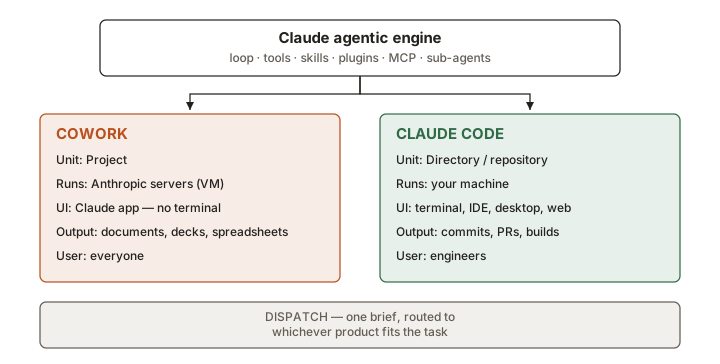
"It's the same agent. Cowork gives it your filing cabinet; Claude Code gives it your codebase."
Anthropic's own version of this point, from its enterprise deployment guide, is sharper still and adds the progression dimension:
Verbatim — Deploying Claude Across Your Organization"Chat is everyone's Level 0. Claude Cowork is where Levels 1 through 4 happen for knowledge work, and Code is where the same progression happens for engineering."
That sentence sits on top of a five-level adoption ladder that does not appear anywhere in the product documentation. It is the best organising device in Anthropic's published material — see §12.
Government / regulated-sector note
Anthropic has published a joint announcement covering "Bringing Claude Code and Claude Cowork to government." If your executive audience includes public-sector or regulated buyers, the existence of a combined government offering is a useful signal that the two are sold as a portfolio, not alternatives.
claude.com/blog/bringing-claude-code-and-claude-cowork-to-government