10 · Which one, when
A decision procedure, role-by-role recommendations, worked scenarios, and the anti-patterns that waste the most time. This is the section your executives will screenshot.
The primary question: what is the artefact?
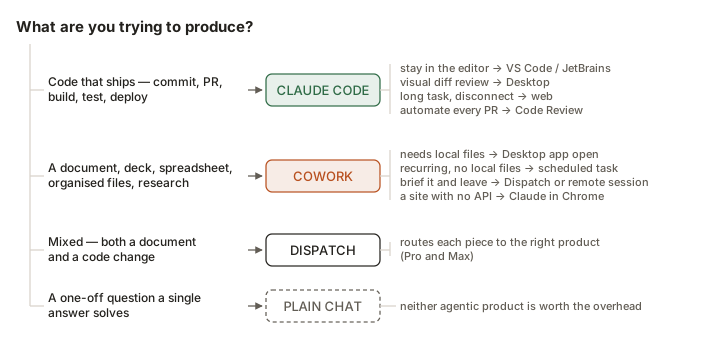
Choose by the output, not by the person. If the finished thing is a document, deck, spreadsheet, tidy folder, or synthesised research → Cowork. If it is a commit, a pull request, a passing test suite, or a deployed change → Claude Code.
Anthropic's administrator guide supplies a usable admission test for the same judgement:
Verbatim — Cowork Enterprise Administrator Guide"An ideal Claude Cowork task produces a deliverable."
If you cannot name the artefact the task will produce, it probably belongs in Chat. That one question filters out most of the misapplied-agent cases before they waste anyone's usage limit.
This works because it survives edge cases. A non-technical operations lead who needs a script that runs in CI still needs Claude Code. An engineer writing an architecture decision record for the board is better served by Cowork.
Decision tree
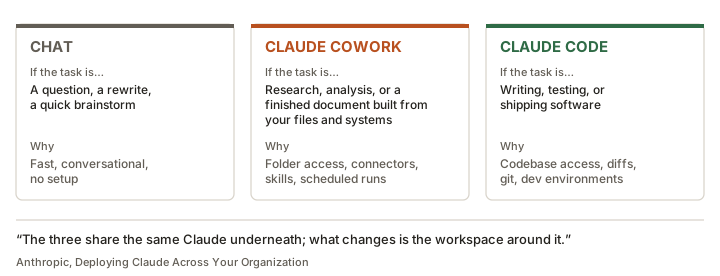
The enterprise deployment guide publishes its own three-way selection table — Chat for "a question, a rewrite, a quick brainstorm"; Cowork for "research, analysis, or a finished document built from your files and systems"; Code for "writing, testing, or shipping software." Reproduced in full in §12. Useful to know you are corroborating them rather than extrapolating.
Secondary constraints that can override the primary answer
| Constraint | Forces you toward | Why |
|---|---|---|
| Content must not leave your machine or network | Claude Code, local | Cowork processes local files on Anthropic's servers by design |
| Work must draw on an internal system reachable only from your network | Claude Code, local | The Cowork environment is separate from your network |
| Billing must go through AWS / Google Cloud / Azure commitments | Claude Code | Bedrock, Claude Platform on AWS, Google Agent Platform, Microsoft Foundry |
| You need a hard, deterministic "never do X" | Claude Code | permissions.deny + PreToolUse hooks; Cowork has no equivalent |
| Everything must land in an auditable compliance trail | Claude Code (or Cowork cloud sessions + OTel) | Cowork local session data isn't in audit logs or the Compliance API |
| The user will never open a terminal, ever | Cowork | That's the entire product thesis |
| The team is on Enterprise seats and wants Dispatch or computer use | Neither — not available | Pro/Max only |
| The setup must be shared and version-controlled across a team | Claude Code | Cowork projects live on one computer and aren't shareable |
| Work must continue overnight with no machine on | Cowork scheduled tasks or Claude Code Routines | Both run on Anthropic infrastructure |
Role-by-role recommendation
| Role | Start with | First thing to try | Watch out for |
|---|---|---|---|
| CEO / GM | Cowork | A recurring Monday briefing built from connected email, calendar and a metrics folder — as a scheduled task. | Scheduled tasks can't read local folders. Keep the source data in connected apps or the Claude account. |
| CFO / Finance | Cowork + the official financial-services plugin set | Model refresh or variance analysis producing an Excel file with working formulas. | Anthropic's own guidance is to avoid granting access to sensitive financial documents while prompt-injection risk exists. Scope folders tightly; use Manual mode. |
| CTO / VP Engineering | Claude Code | Roll out to one team with a committed CLAUDE.md, then measure with the analytics dashboard. | Governance first — managed settings and deny rules before broad enablement. |
| CMO / Marketing ops | Cowork | Campaign post-mortem: pull the numbers, build the deck, draft the summary. | Usage limits. Agentic deck-building is expensive; consider Max for heavy users. |
| General Counsel / Legal | Cowork, cautiously | Contract organisation and clause extraction across a folder. | The compliance-trail gap. Get a written position from your Anthropic account team before regulated use. |
| CISO / Risk | Read §08 first | Stand up an OTel collector for Cowork before anyone uses it in anger. | user.email is always in the telemetry; egress rules don't cover web fetch, web search or MCP. |
| Sales leadership | Cowork | Pre-meeting account brief assembled from CRM connector, email and the web. | Browser use and local files need the desktop app open and the machine awake. |
| Chief of Staff / Ops | Cowork, then Dispatch | Weekly cross-functional status roll-up. Then brief it from your phone. | Dispatch is Pro/Max only. Child tasks can complete partially if a permission prompt times out after 10 minutes. |
| Data / Analytics lead | Both | Cowork for the narrative and the deck; Claude Code for the pipeline and the notebooks. | They don't share configuration — a skill in ~/.claude won't show up in Cowork. |
Worked scenarios
Scenario A — "Prepare the board pack"
Answer: Cowork. Local folders of source material, connectors for the live numbers, and a PowerPoint deliverable with formatted tables. Set up a project holding the board folder plus standing instructions about house style and required sections. Run it in Manual mode the first time so you can see the plan; move to Auto once you trust the shape.
Scenario B — "Migrate 400 files off a deprecated internal library"
Answer: Claude Code, dynamic workflows or /batch. This is exactly the case the workflows documentation names ("a 500-file migration"). Worktree isolation prevents collisions; each subagent opens its own PR for review.
Scenario C — "Every Monday at 7am, tell me what changed in our competitive landscape"
Answer: Cowork scheduled task. Runs remotely, no machine required, uses your connectors and web search. Constraint to design around: it cannot read a folder on your laptop, so the output should land in a connected service or your Claude account.
Scenario D — "Our incident review process is inconsistent across teams"
Answer: a plugin. This is the one case where the right answer is neither product but the shared layer. Package the process as a skill inside a plugin, publish it to an internal git-repo marketplace, and mark it Required for the org. It then works in both Cowork and Claude Code, for both the SRE writing the timeline and the comms lead writing the customer note.
Scenario E — "I want the AI to fix the bug I found on my phone at the airport"
Answer: Dispatch (Pro/Max) or Claude Code on mobile. Dispatch routes it to a Code session on your desktop at home; Claude Code on the web/mobile runs it in Anthropic's cloud without your machine. Choose based on whether the repo is checked out locally.
Scenario F — "Summarise this 40-page PDF"
Answer: neither. Plain Claude Chat. Do not spin up an agentic session for a task that one model call solves. Teaching people when not to use these products protects your credibility and their usage limits.
Anti-patterns
| Anti-pattern | Why it hurts | Do instead |
|---|---|---|
| Using Cowork for one-shot questions | Burns limits far faster than Chat for no benefit | Use Chat. Reserve Cowork for multi-step work with a deliverable. |
| Micromanaging the steps | Both products are designed around "say what, not how." Step-by-step prompting fights the architecture. | State the outcome and the constraints. Let it plan. |
| Connecting your whole home folder | Widens the trust boundary enormously; Anthropic explicitly advises against granting access to sensitive documents | Connect the narrowest folder that contains the work. |
| Running unattended, Auto mode, with write-capable connectors, on web-sourced content | This is precisely the two-condition prompt-injection scenario | Break one condition: Manual mode, or read-only connectors, or no web access. |
| Putting everything in CLAUDE.md / project instructions | Costs context on every request and reduces adherence | Rules in instructions; reference material in skills. |
| Expecting a Claude Code skill to appear in Cowork | Cowork doesn't read ~/.claude | Add it in Customize, or package it as a plugin. |
| Treating CLAUDE.md as a security control | "An instruction… is a request, not a guarantee" | Hooks and permissions.deny for anything that must hold. |
| Demoing Dispatch or computer use to an Enterprise audience | Not available on their plan | Check the seat type before you build the demo. |
| Assuming an unattended Dispatch task completed fully | Unanswered permission prompts auto-deny after 10 minutes and the task continues | Read the transcript, not just the final artefact. |
| Promising Zero Data Retention for Cowork | Not documented for Cowork; ZDR is not in the standard Enterprise plan either | Route the question to the Anthropic account team. |
A staged adoption path to recommend
Anthropic publishes its own six-month Evaluate / Pilot / Scale roadmap tied to the five-level maturity ladder (§12). It agrees with the path below on shape — champions first, encode second, distribute third — but is more concrete on timing, while mine adds an explicit instrumentation step before scaling. Show whichever fits the room, and say which one you are showing.
| Stage | What happens | Success signal |
|---|---|---|
| 1 · Chat literacy | Everyone gets comfortable with plain Claude and learns when a single answer is enough. | People stop over-specifying prompts. |
| 2 · Cowork pilot, narrow scope | One team, one recurring deliverable, one connected folder, Manual permission mode. | A real artefact ships that would otherwise have taken a person half a day. |
| 3 · Instrument | Turn on OTel (Team/Ent.). Decide the content-capture posture deliberately. | You can answer "who used what, and what did it cost" without asking anyone. |
| 4 · Standardise | Package the pilot's hard-won conventions as a plugin. Mark it Required. | A second team gets the same quality on day one. |
| 5 · Engineering rollout | Claude Code with managed settings, committed CLAUDE.md, permission policy. Use Anthropic's champion and communications kits. | Analytics dashboard shows sustained weekly active use, not a spike. |
| 6 · Connect the two | Dispatch where plans allow; shared plugins everywhere. | A single brief produces both the code change and the stakeholder note. |
"The question isn't 'which product'. It's 'what am I willing to delegate, and how would I know if it went wrong?' Answer that, and the product choice makes itself."